
ICD-10 Coding for Skin Tags: Medical Necessity vs Cosmetic Removal
By Billmate
Jan. 20, 2026, 7:34 a.m.
Introduction
Skin tag removal is one of the most common minor procedures performed in primary care, dermatology, and outpatient settings. Despite its routine nature, coding and billing for skin tag removal remains one of the most frequently misunderstood areas in medical billing. The confusion primarily arises from the distinction between medically necessary removal and cosmetic removal, which directly impacts reimbursement. For doctors, clinic managers, healthcare providers, and billing professionals, understanding the correct ICD-10 coding for skin tags, appropriate CPT codes for skin tag removal, and payer expectations is critical to avoiding denials, audits, and lost revenue.
This in-depth guide explains everything you need to know about skin tag ICD-10 codes, including how to link diagnosis codes with procedure codes, when removal is covered, and how to document medical necessity versus cosmetic intent—using payer-aligned best practices.
Why Skin Tag Coding Requires Careful Attention
Skin tags are benign growths that commonly appear in areas of friction such as the neck, axilla, groin, and eyelids. While usually harmless, they may cause symptoms that justify medical removal. From a billing perspective, however, payers do not reimburse simply because a skin tag exists. Coverage depends entirely on medical necessity, which must be supported by accurate ICD-10 coding, proper CPT selection, and clear clinical documentation. Incorrect coding, such as billing cosmetic removal as medically necessary or using vague diagnosis codes, can result in:
- Claim denials
- Patient billing disputes
- Refund demands
- Audit exposure
Understanding the difference between ICD-10 for skin tags and CPT procedure codes is essential for compliant billing.
What Is a Skin Tag? (Clinical & Coding Overview)
A skin tag is a soft, pedunculated, benign lesion composed of fibrous tissue and blood vessels. In medical terminology, skin tags are known as acrochordons or fibroepithelial polyps. Although they are benign, skin tags may become problematic when they:
- Bleed due to friction
- Become inflamed or infected
- Cause pain or irritation
- Interfere with daily activities or clothing
- Obstruct vision or movement
Only under these circumstances can removal be considered medically necessary.
ICD-10 Coding Basics for Skin Tags

ICD-10 diagnosis codes explain why a procedure was performed. When billing for skin tag removal, the diagnosis code must justify the medical necessity of the service.
Most Common ICD-10 Codes for Skin Tags
The primary and most widely accepted ICD-10 code for a skin tag is:
- L91.8 – Other hypertrophic disorders of the skin
This code is commonly used for:
- Skin tags
- Acrochordons
- Fibroepithelial polyps
You may see it referenced interchangeably as:
skin tag ICD-10
- ICD-10 for skin tag
- ICD-10 for skin tags
- ICD-10 code for skin tag
All refer to the same diagnostic classification when using L91.8.
- ICD-10 for Acrochordon and Fibroepithelial Polyp
- ICD-10 for Acrochordon
- L91.8 is the correct ICD-10 code for acrochordon
Fibroepithelial Polyp ICD-10
- Also coded as L91.8
These terms describe the same benign lesion, and ICD-10 does not differentiate between them with separate codes.
When ICD-10 Skin Tag Coding Is NOT Enough
A key billing mistake is assuming that L91.8 alone guarantees coverage. It does not. Payers often require additional ICD-10 codes to demonstrate symptoms or complications, such as:
- Pain
- Bleeding
- Inflammation
- Functional impairment
Without symptom-based diagnosis codes, removal is usually classified as cosmetic.
Medical Necessity vs Cosmetic Removal

The most important factor in skin tag billing is determining whether the procedure is medically necessary or cosmetic.
Cosmetic Skin Tag Removal
Cosmetic removal occurs when:
- The skin tag is asymptomatic
- Removal is requested for appearance only
- There is no documented complication
Cosmetic services are:
- Not covered by insurance
- Patient-pay only
- Must be disclosed in advance
- Medically Necessary Skin Tag Removal
Removal may be considered medically necessary when the skin tag:
Causes pain or tenderness
- Bleeds repeatedly
- Is frequently irritated by clothing or jewelry
- Is inflamed or infected
- Interferes with function (vision, movement)
In these cases, documentation, not just coding, determines coverage.
CPT Code for Skin Tag Removal
CPT codes describe what procedure was performed. For skin tag removal, CPT selection depends on the number of lesions and method of removal.
Common CPT Codes for Removal of Skin Tags
The most commonly used CPT codes include:
- 11200 – Removal of skin tags, up to and including 15 lesions
- 11201 – Each additional 10 lesions (add-on code)
These codes apply to removal by:
- Snipping
- Shaving
- Electrocautery
- Cryotherapy (when appropriate)
You may see them referenced as:
- CPT code for skin tag removal
- CPT code for excision of skin tag
- CPT code for removal of skin tags
CPT Code for Excision of Skin Tag vs Lesion Excision
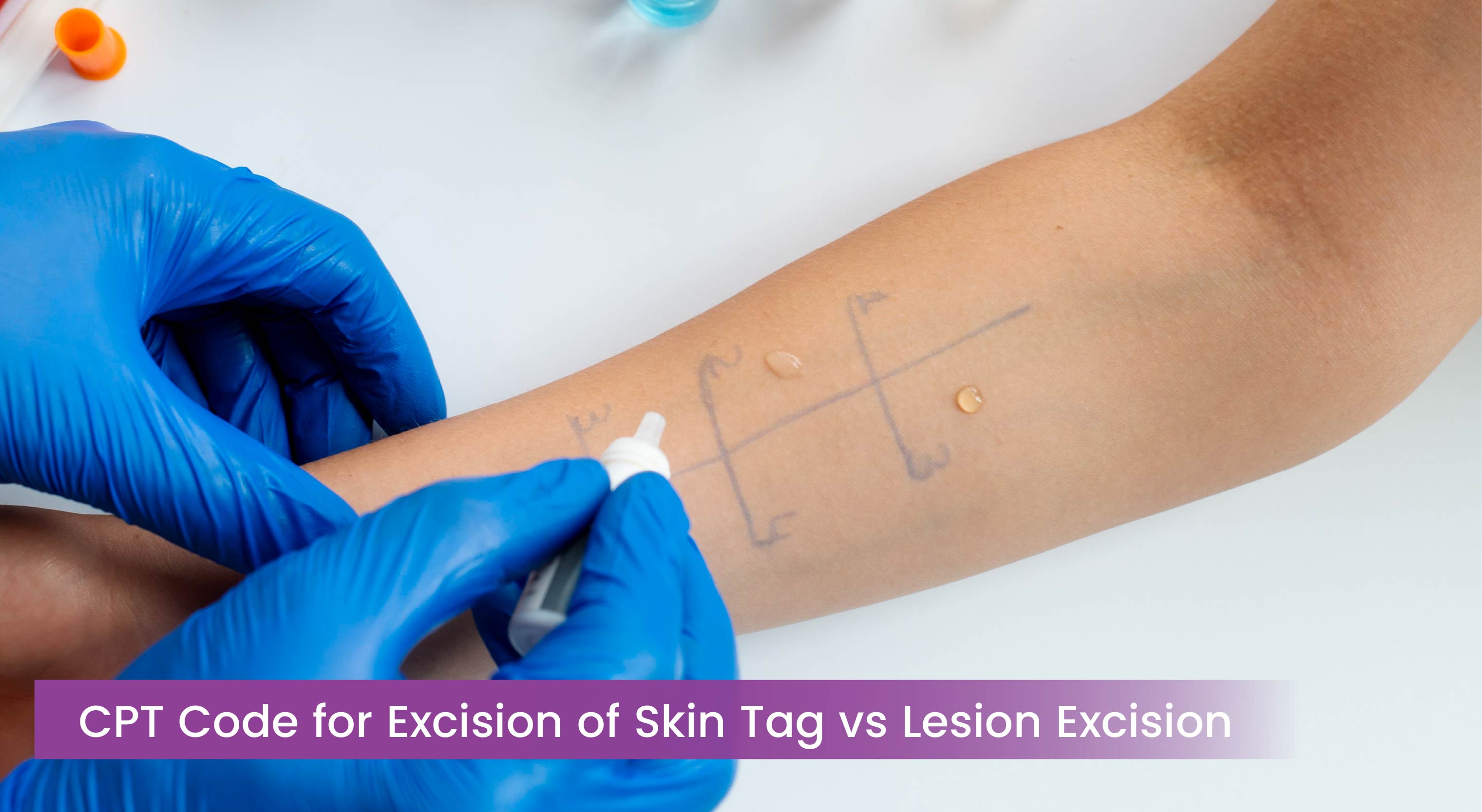
A common mistake is using lesion excision codes (11400–11446) for skin tags. This is usually incorrect. Skin tags are not typically coded as excised lesions unless:
- They are unusually large
- Full-thickness excision is performed
- Pathology is sent
In most routine cases, 11200/11201 are the correct CPT codes.
Linking ICD-10 and CPT Codes Correctly
To ensure reimbursement, the ICD-10 code for a skin tag must logically support the CPT code for removal.
Correct Coding Example (Medical Necessity)
- ICD-10: L91.8 (skin tag)
- Additional ICD-10: R20.2 (pain), L30.4 (intertrigo), or bleeding-related code
- CPT: 11200
Incorrect Coding Example (Denial Risk)
- ICD-10: L91.8 only
- CPT: 11200
- Documentation: “Patient requests removal for cosmetic reasons.”
This combination almost always results in denial.
Skin Tag Removal ICD-10 and Associated Conditions
Skin tags may be confused with or associated with other dermatologic conditions.
Heat Rash ICD-10
- L74.0–L74.9 (miliaria)
Heat rash is not a skin tag and should never be used to justify skin tag removal unless clearly documented as a separate condition.
ICD-10 Skin Tag vs Other Benign Lesions
- Skin tags: L91.8
- Warts: B07.9
- Seborrheic keratosis: L82.1
Using the wrong diagnosis code can invalidate the claim.
Documentation Requirements for Medical Necessity
Documentation is the deciding factor in coverage. Payers often request records during audits.
Strong documentation should include:
- Size and location of skin tag(s)
- Symptoms (pain, bleeding, irritation)
- Duration of symptoms
- Failed conservative management (if applicable)
- Clinical rationale for removal
Guidance from the Centers for Medicare & Medicaid Services emphasizes that documentation must clearly support medical necessity for reimbursement.
Medicare and Commercial Insurance Considerations

Medicare
Medicare generally considers skin tag removal non-covered unless medically necessary. Coverage decisions are based on:
- Symptoms
- Functional impairment
- Risk of complications
Commercial Payers
Commercial insurers follow similar logic but may have stricter cosmetic exclusions.
Coding guidance from the American Academy of Professional Coders consistently highlights the importance of symptom-based ICD-10 coding for skin tag claims.
Common Billing Errors in Skin Tag Coding
Frequent mistakes include:
- Billing cosmetic removal to insurance
- Using L91.8 without symptom codes
- Selecting lesion excision CPT codes incorrectly
- Inadequate documentation
- Failing to inform patients of non-coverage
These errors increase denial rates and patient dissatisfaction.
Best Practices for Accurate Skin Tag Coding

To reduce denials and improve compliance:
- Always assess and document medical necessity
- Use L91.8 with supporting symptom codes when appropriate
- Select 11200/11201 for routine removal
- Obtain patient consent for cosmetic services
- Educate staff on payer-specific policies
- Perform internal coding audits regularly
For practices seeking expert support, professional billing services can significantly reduce risk and administrative burden.
Frequently Asked Questions (FAQs)
1. What is the ICD-10 code for skin tag?
The most common code is L91.8.
2. What is the ICD-10 for acrochordon?
Acrochordon is coded as L91.8.
3. What CPT code is used for skin tag removal?
Typically 11200 (up to 15 lesions) and 11201 for additional lesions.
4. Is skin tag removal covered by insurance?
Only when medically necessary and properly documented.
5. Can heat rash ICD-10 be used for skin tag removal?
No. Heat rash is a separate condition and does not justify skin tag removal.
Conclusion
Accurate ICD-10 coding for skin tags is not just a technical requirement; it is the foundation of compliant, reimbursable care. Distinguishing medical necessity from cosmetic removal, selecting the correct CPT code for skin tag removal, and documenting symptoms clearly are essential steps for avoiding denials and protecting revenue. As payer scrutiny increases, providers must adopt proactive coding and documentation strategies to ensure compliance and patient transparency.
Are skin tag claims being denied or flagged as cosmetic?
What To Read Next

By Billmate | March 11, 2026
How to Read a Health Insurance Card in 2026: Complete Guide for Patients & Providers
Learn how to read a health insurance card in 2026, including policy number, member ID, group number…

By Billmate | March 10, 2026
10 Benefits of Hiring a Medical Billing Company in the USA
Discover the top benefits of hiring a medical billing company in the USA to improve revenue cycle m…

By Billmate | March 06, 2026
99213 CPT Code Explained: Complete Guide to Documentation, Billing, and Reimbursement
Complete guide to 99213 CPT code, documentation requirements, billing rules, reimbursement, and pro…

By Billmate | March 04, 2026
Weight Loss ICD-10 Codes Explained: A Complete Guide for Accurate Medical Billing
Complete 2026 guide to weight loss ICD-10 codes, including abnormal weight loss, unintentional weig…

By Billmate | March 02, 2026
A Complete Guide to POS 11 and Other Key POS Codes in Medical Billing
Comprehensive 2026 guide to POS 11 in medical billing and other key POS codes, including POS 22, 23…
Join our team to be a part
of our story
Learn more about our career, education and
posting jobs, and
submit simple application.