
Tick Bite ICD-10 Codes and Billing Guide for Accurate Medical Coding
By Billmate
Feb. 20, 2026, 5:42 a.m.
Introduction
Tick bites are increasingly common across the United States, especially in warmer months and wooded regions. While many tick bites are harmless, some can transmit serious illnesses such as Lyme disease, Rocky Mountain spotted fever, and other tick-borne infections. From a clinical perspective, timely diagnosis and treatment are critical. From a billing and coding perspective, accuracy is equally important. Improper documentation or incorrect ICD-10 coding for tick bites can lead to denied claims, compliance risks, and reimbursement delays. Whether you are a primary care provider, urgent care center, emergency department, or billing specialist, understanding the correct tick bite ICD-10 codes, appropriate CPT codes for tick removal, and related Lyme disease coding guidelines is essential for accurate reimbursement.
This comprehensive 2026 guide explains ICD-10 tick bite coding, how to document suspected or confirmed Lyme disease ICD-10, when to use rash-related codes such as R21 diagnosis code, and how professional medical billing services like BillMate can support compliance and revenue integrity.
Understanding Tick Bite Coding in Clinical Practice
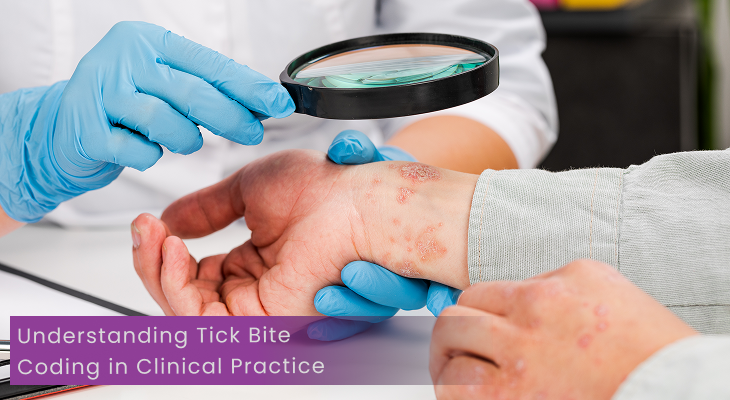
Tick bite encounters can range from simple removal visits to complex diagnostic workups involving laboratory testing and infectious disease management. The key to accurate coding lies in identifying whether the encounter involves:
A simple tick bite without complication
- Local reaction or rash
- Suspected Lyme disease
- Confirmed Lyme disease
- Systemic symptoms
- Tick removal procedure
Each scenario requires different ICD-10 and CPT coding considerations.
Tick Bite ICD-10 Code: Primary Diagnosis Coding
When documenting a tick bite, ICD-10 coding depends on whether the encounter is for an initial injury, follow-up, or complication.
ICD-10 Code for Tick Bite
The primary ICD-10 code for a tick bite is typically found under:
W57.XXXA – Bitten or stung by a nonvenomous insect and other nonvenomous arthropods, initial encounter
Since ticks are classified as arthropods, this code is commonly used for initial encounters involving a tick bite.
For subsequent encounters, the 7th character changes accordingly:
W57.XXXD – Subsequent encounter
W57.XXXS – Sequela
Accurate use of the 7th character is essential for compliance.
ICD-10 Tick Bite with Local Reaction
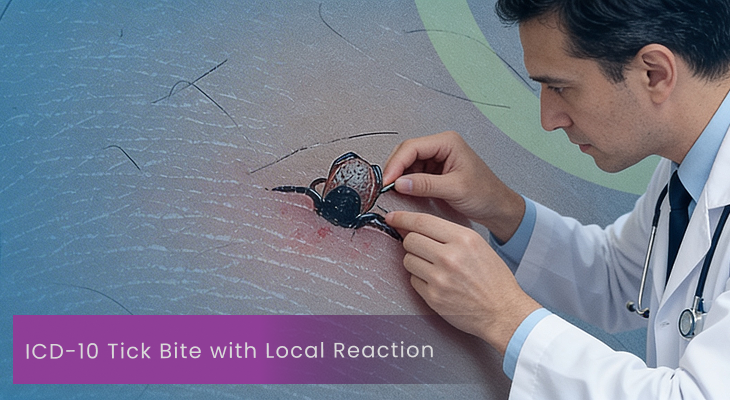
If a tick bite results in localized inflammation, rash, or irritation, additional diagnosis codes may be required. For example:
R21 diagnosis code – Rash and other nonspecific skin eruption
R21 is appropriate when a rash is documented, but no specific infectious cause has been confirmed. However, if erythema migrans is diagnosed (a hallmark of early Lyme disease), a more specific code should be used.
Lyme Disease ICD-10 Coding
Lyme disease is one of the most significant tick-borne illnesses and requires precise coding.
ICD-10 Code for Lyme Disease
The primary code is:
A69.20 – Lyme disease, unspecified
When documentation specifies organ involvement, more detailed codes may apply.
For example:
A69.21 – Meningitis due to Lyme disease
A69.22 – Other neurologic disorders in Lyme disease
Accurate documentation determines whether to use unspecified or specific Lyme disease codes.
Erythema Migrans ICD-10
Erythema migrans is the characteristic “bull’s-eye” rash associated with early Lyme disease. Once erythema migrans is documented and clinically diagnosed, coding should reflect Lyme disease rather than a nonspecific rash. Although there is no separate ICD-10 code exclusively for erythema migrans, it is typically coded under A69.20 when Lyme disease is confirmed.
If Lyme disease has not yet been confirmed but erythema migrans is strongly suspected, documentation must clearly reflect clinical judgment to support correct coding.
When to Use R21 Diagnosis Code

Lyme Disease ICD-10 and Confirmed Diagnosis
The R21 diagnosis code is appropriate only when:
- A rash is present
- The underlying cause is not yet identified
- Lyme disease has not been confirmed
Using R21 after Lyme disease is confirmed would be incorrect and could trigger audit scrutiny.
ICD-10 Code for Tick Removal Encounters
There is no specific ICD-10 code exclusively labeled as “tick removal.” Instead, coding reflects:
- The tick bite (W57.XXXA)
- Any associated condition (e.g., R21, A69.20)
Documentation must clearly describe:
- Location of bite
- Presence or absence of infection
- Whether the tick was removed
CPT Code Tick Removal
Tick removal is typically billed using minor surgical procedure codes rather than a dedicated tick removal code.
Common CPT code options include:
- 10120 – Incision and removal of foreign body, subcutaneous tissues
- 10060 – Incision and drainage of abscess (if applicable)
If the tick is easily removed without incision, it may be considered part of the evaluation and management (E/M) service and not separately billable.
Correct CPT code tick removal selection depends on:
- Complexity
- Depth of removal
- Documentation
Lyme Disease ICD-10 and Confirmed Diagnosis
When Lyme disease is laboratory-confirmed, coding must reflect the confirmed infectious condition. Continued use of tick bite or rash codes after confirmation may result in undercoding or compliance risk.
Thorough documentation should include:
- Diagnostic testing results
- Clinical signs and symptoms
- Treatment plan
Accurate ICD-10 coding for Lyme disease ensures appropriate reimbursement and risk adjustment accuracy.
Common Coding Errors in Tick Bite Encounters
Tick bite encounters often result in coding errors, such as:
- Using R21 instead of A69.20 after confirmation
- Failing to include 7tthe h character in W57.XXXA
- Billing CPT tick removal without proper documentation
- Coding suspected Lyme disease as confirmed without evidence
Preventing these errors requires strong documentation practices and coding review.
Medical Necessity and Documentation Standards
Medical necessity must support both diagnosis and procedure coding. For example, if a patient presents solely for reassurance and no procedure is performed, billing a removal code may not be appropriate. Payer guidelines, often aligned with standards from the Centers for Medicare & Medicaid Services, require documentation that supports services billed.
Billing Workflow for Tick Bite Encounters
A structured workflow improves compliance and reimbursement accuracy:
- Verify patient insurance eligibility
- Document tick bite details thoroughly
- Assign appropriate ICD-10 tick bite or Lyme disease codes
- Determine whether tick removal qualifies for CPT billing
- Submit clean claims with complete documentation
- Each step reduces denial risk.
The Role of Professional Medical Billing Services

Tick bite encounters may appear simple, but coding nuances can lead to revenue loss if handled improperly. Professional medical billing services help healthcare providers:
Ensure accurate ICD-10 and CPT coding
- Reduce claim denials
- Maintain compliance
- Optimize reimbursement
Partnering with experienced billing experts like BillMate ensures that even seemingly routine encounters are coded and billed correctly.
Preventing Denials in Tick Bite Billing
To minimize denials:
- Confirm whether Lyme disease is suspected or confirmed
- Avoid vague documentation
- Use appropriate 7th character extensions
- Verify payer policies regarding minor procedures
Clear documentation and accurate coding reduce payer disputes.
Frequently Asked Questions (FAQs)
1. What is the ICD-10 code for a tick bite?
The most common code is W57.XXXA for initial encounter involving a nonvenomous insect or arthropod bite.
2. What is the ICD-10 code for Lyme disease?
The primary code is A69.20 for unspecified Lyme disease.
3. When should the R21 diagnosis code be used?
R21 should be used only when a rash is present without a confirmed underlying cause, such as Lyme disease.
4. Is there a specific CPT code for tick removal?
There is no unique CPT code solely for tick removal. Codes like 10120 may apply depending on complexity and documentation.
5. Can suspected Lyme disease be coded as confirmed?
No. Only confirmed diagnoses should be coded as Lyme disease. Suspected cases should use symptom-based codes until confirmed.
Conclusion
Accurate coding for tick bite encounters requires careful documentation and a clear understanding of ICD-10 and CPT guidelines. From tick bite ICD-10 codes to Lyme disease ICD-10, and from rash coding to CPT tick removal billing, each detail impacts reimbursement and compliance. Healthcare providers who invest in structured billing workflows and professional support, such as BillMate’s medical billing services, can significantly reduce denials and protect revenue.
Need help optimizing your tick bite and infectious disease billing?
Schedule Your Free Consultation Today and let BillMate’s expert medical billing services ensure
accurate coding, compliance, and maximum reimbursement for your practice.
What To Read Next

By Billmate | March 11, 2026
How to Read a Health Insurance Card in 2026: Complete Guide for Patients & Providers
Learn how to read a health insurance card in 2026, including policy number, member ID, group number…

By Billmate | March 10, 2026
10 Benefits of Hiring a Medical Billing Company in the USA
Discover the top benefits of hiring a medical billing company in the USA to improve revenue cycle m…

By Billmate | March 06, 2026
99213 CPT Code Explained: Complete Guide to Documentation, Billing, and Reimbursement
Complete guide to 99213 CPT code, documentation requirements, billing rules, reimbursement, and pro…

By Billmate | March 04, 2026
Weight Loss ICD-10 Codes Explained: A Complete Guide for Accurate Medical Billing
Complete 2026 guide to weight loss ICD-10 codes, including abnormal weight loss, unintentional weig…

By Billmate | March 02, 2026
A Complete Guide to POS 11 and Other Key POS Codes in Medical Billing
Comprehensive 2026 guide to POS 11 in medical billing and other key POS codes, including POS 22, 23…
Join our team to be a part
of our story
Learn more about our career, education and
posting jobs, and
submit simple application.